
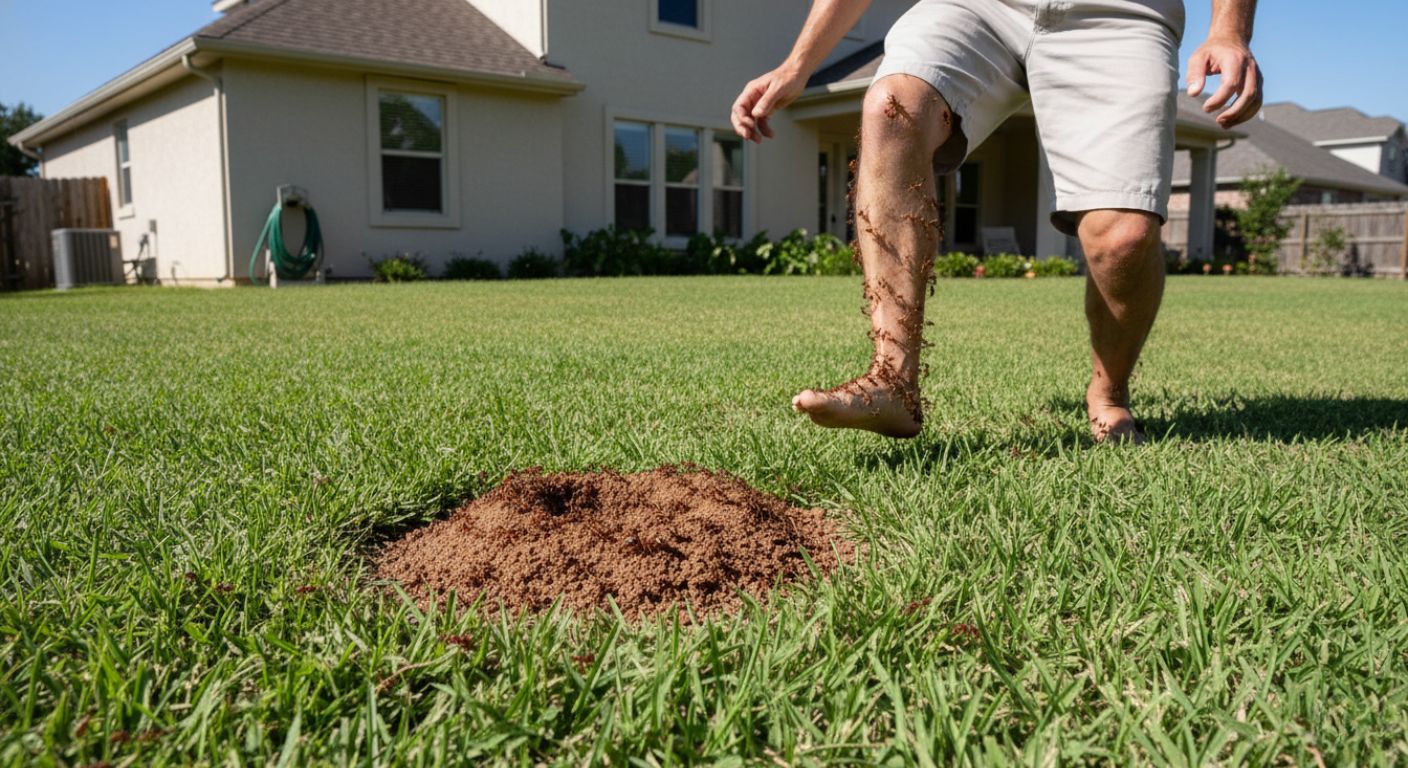
Last month, on a Sunday, I stepped outside barefoot for literally two seconds. And suddenly my ankle is on fire. Within a minute, there are dozens of tiny red ants swarming up my leg, stinging over and over, and the next morning I wake up to small white bumps all over the skin. On the same day, my dog went near the fence, disturbed something, and came running back scratching like crazy.
Then I researched properly and I found that these are the fire ants. If you are facing the same problem and tried many remedies and repellents, but they are useless and still finding a permanent solution, you are at the right place. This is seriously a big problem. As per my experience, this guide covers how to kill fire ants the right way, how to treat the stings at home, and how to stop them from showing up again every few weeks.
Quick Answer – How to Get Rid of Fire Ants
- Fire ants can be eliminated in two ways: first, using a slow-acting granular bait and second, directly treating the mound properly.
- The main job of fire ant worker ants is to carry forage throughout the colony. Worker ants carry forage deep into the colony, eventually killing the queen ant and destroying the entire mound.
- If the colony is large and the treatment is done correctly, the colony is usually completely eliminated within 1 to 6 weeks.
At the beginning I made a mistake and most people do it. They just dump something on the visible mound and call it done. But the mound is only what you see above the ground. The real colony is underground, sometimes a few feet deep and the queen is tucked away safely inside. If she survives, the colony rebuilds. Often bigger than before. So the whole goal of fire ant treatment is to reach the queen. Everything else is just surface-level relief.
What Are Fire Ants?
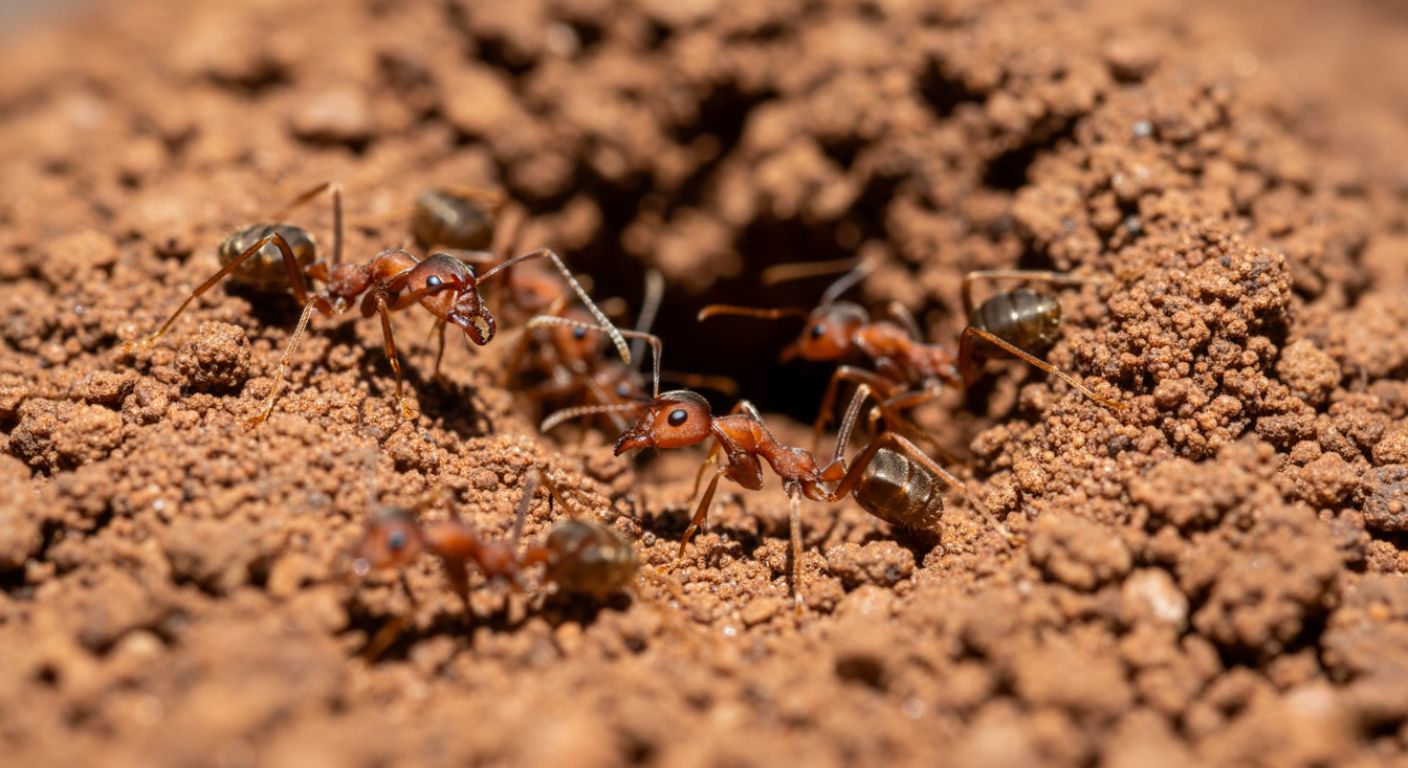
Fire ants are aggressive stingers. Fire ant colonies build mounds of earth underground and often contain millions of worker ants. A fire ant’s sting releases venom that causes a severe burning and itchy rash. A mature colony can have anywhere from 100,000 to 500,000 individual ants. Some super-colonies with multiple queens are even bigger. So no, these are not something that just goes away on their own, you need to do proper treatment.
I see a random pile of loose dirt in the lawn. Looks harmless. I step on it while mowing and within seconds the ground looks alive. Fire ants pour out fast and start climbing my shoes, my socks, my leg, stinging without any warning at all.
The most common one in the U.S. is the Imported Red Fire Ant which accidentally brought over from South America back in the 1930s. It spread across the southern states incredibly fast and has been a problem ever since, especially in Texas, Florida, Georgia, Alabama, and the Carolinas.
What makes fire ants different from most ants is how they attack. It’s not one sting. Dozens of ants sting simultaneously. Each ant can sting multiple times. And they swarm upward within seconds of a disturbance, so by the time you realize what’s happening, you’ve already been stung several times. That group attack is what makes them genuinely dangerous, not just annoying.
Fire Ant Quick Identification
| Feature | What You’ll See |
|---|---|
| Size | 1/8 to 1/4 inch long |
| Color | Reddish-brown, darker abdomen |
| Behavior | Extremely aggressive swarms fast when disturbed |
| Nest Type | Dome-shaped dirt mounds in open soil |
| Bite or Sting? | Both bites to grip, then stings repeatedly |
| Pain Level | Burning and intense, starts immediately |
| Colony Size | Up to 250,000+ ants per colony |
| Activity Peak | Warm weather, especially right after rain |
Why Fire Ants Are in Yard (or Getting Inside the House)
Most fire ant yards have the same pattern: soft damp soil, open sun, and easy food nearby. Once a colony settles in, the mounds start showing up fast. Overwatered lawns, exposed food, pet food, and disturbed soil create ideal conditions for fire ant colonies. Heavy rain frequently forces fire ant colonies to relocate closer to homes.
Last year it rained for a week, and after that, these mud houses were everywhere like driveways, mailboxes, garden beds, fences. Then, through research, I found that flooding and waterlogged soil force fire ant colonies to move upward and find dry ground faster, which is usually near foundations or sidewalks.
At first, I thought they were just showing up randomly, but after a while I noticed they always appeared in the same kinds of spots. Open sunny lawn with loose soil, perfect for them. A yard with overwatered grass, outdoor pet bowls, fallen fruit, or wood piles near the house is even better. Understanding what attracted them makes it easier to treat and prevent.
Common Causes and the Fix
| Cause | What Happens | Fix |
|---|---|---|
| Overwatered lawn | Soft moist soil easy to build mounds | Water less frequently |
| Pet food left outside | Attracts foraging worker ants | Remove bowls after every feeding |
| Fallen fruit or sugary spills | Creates a food trail | Clean up immediately |
| Mulch touching foundation | Warmth and shelter near the house | Keep a dry perimeter |
| Wood piles and yard debris | Hidden nesting spots | Remove clutter |
| Cracks in foundation | Entry points for indoor fire ants | Seal gaps with caulk |
| Heavy rain or flooding | Forces colonies to relocate fast | Treat proactively after storms |
Signs You Have a Fire Ant Infestation
Visible dirt mounds and painful stings are the most obvious signs of fire ants. My parent’s house, lawn looked completely normal yesterday. Today there are three fresh mounds near the driveway. Almost overnight. That’s just how fire ants work, they build fast, especially after weather changes.
What Fire Ant Mounds Look Like
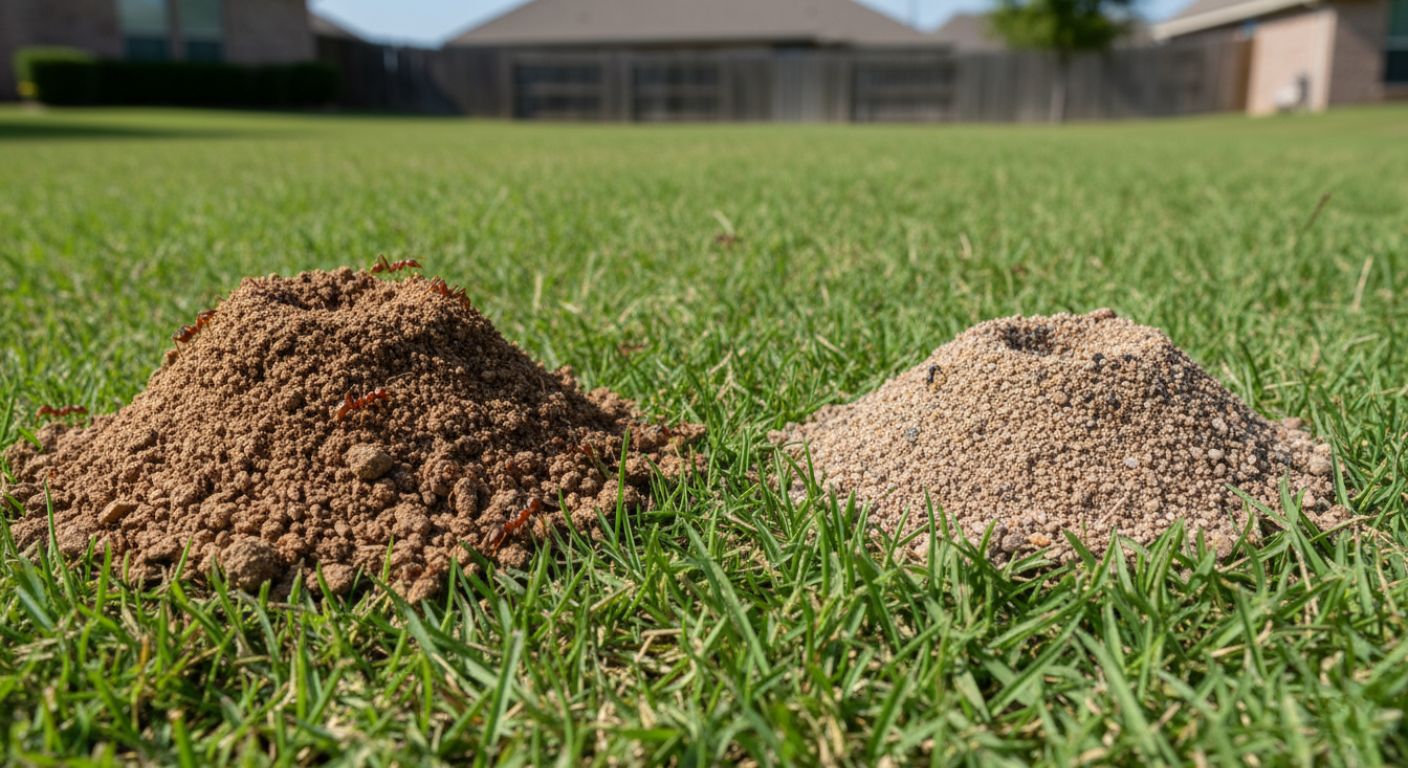
These appear as dome-like mounds of loose, fluffy soil. They are typically 4 to 18 inches wide and a few inches high. Entry tunnels enter the ground from around the outer edges, not the center. Therefore, there is no visible hole on top. Fresh mounds often look as if someone has dumped handfuls of loose soil on the grass.
They are most commonly seen in sunny, open lawn areas, near sidewalks, driveways, around utility boxes, near garden beds, and under trees or fenceposts.
The Sudden Swarm
If you step on a mound, kick it, or even let your lawnmower pass too close, the reaction is almost instantaneous. Ants emerge within seconds and begin climbing. Many sting at once. The first time this happens, it’s a shock because most ants simply run away. Fire ants will attack you.
Fire Ants Showing Up Indoors
It usually happens after a storm or heavy rain. Fire ants come in searching for water, grease, or food most commonly near kitchen sinks, laundry rooms, bathrooms, and around pet bowls. Finding them indoors almost always means there’s a colony right outside near the foundation. Treating only indoors won’t fix it.
The White Bumps the Next Morning
This is actually how a lot of people figured out it was fire ants. The sting burns immediately, then the itching starts the next morning with small white fluid-filled pustules exactly where the burning happened. That burn then blister pattern is very specific to fire ants. If you have unexplained blisters on your feet or ankles, check your yard for mounds.
Fire Ant Bites vs. Fire Ant Stings: Is There a Difference?
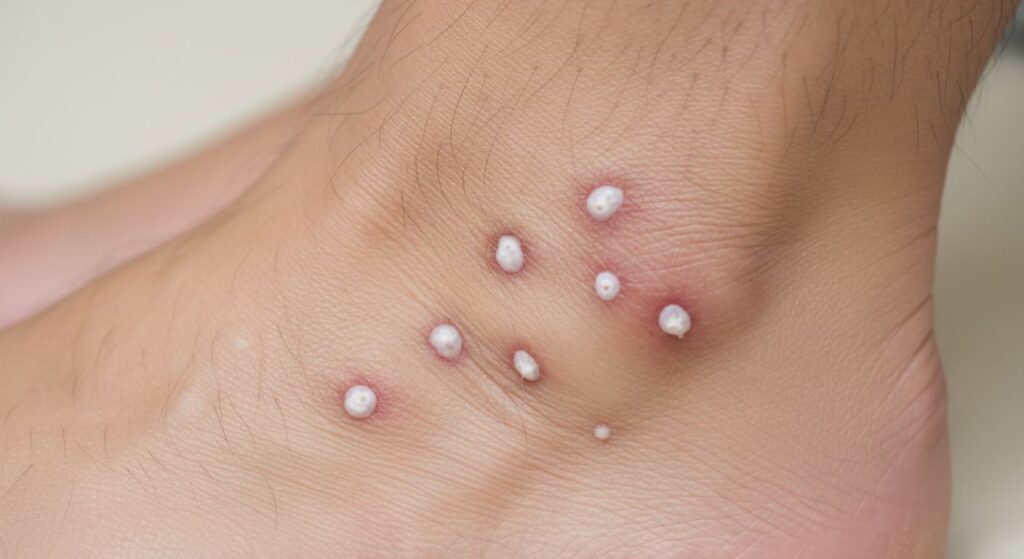
Technically, fire ants bite to stabilize themselves and then sting repeatedly with venom. A fire ant sting causes a burning sensation followed by an itchy white rash. A severe allergic reaction requires immediate emergency medical attention.
Both biting and stinging happened at the same time. The ant bites and holds the victim with its jaws, then turns around and stings multiple times in a small circle with its rear end. The bite is barely noticeable. The sting is everything. It can sting 20 or 30 times in less than a minute.
When I was stung by a fire ant, I realized the next morning that it was caused by fire ants. Most people only realize it’s caused by fire ants when the next morning itching begins and small white bumps appear at the site of the burn. The pattern is clear: burning first, blisters the next day.
People with known insect venom allergies need to be extra careful. Anaphylaxis from fire ant stings is rare but it does happen throat swelling, trouble breathing, fast heart rate, dizziness. That’s a 108 situation. Anyone with a known allergy should carry an epinephrine auto-injector and not wait to see if symptoms improve on their own.
Normal Reaction vs. When to Worry
| Symptom | Normal Reaction | Serious Get Help |
|---|---|---|
| Burning pain | Yes, immediately | Yes, more intense |
| White pustules | Appear within 24 hrs | Yes |
| Swelling | Mild, near sting site | Severe or spreading |
| Itching | Common | May be extreme |
| Trouble breathing | No | Emergency call 911 |
| Dizziness | No | Emergency call 911 |
| Chest tightness | No | Emergency call 911 |
| Hives beyond sting area | No | Possible allergic reaction |
How to Treat Fire Ant Stings at Home
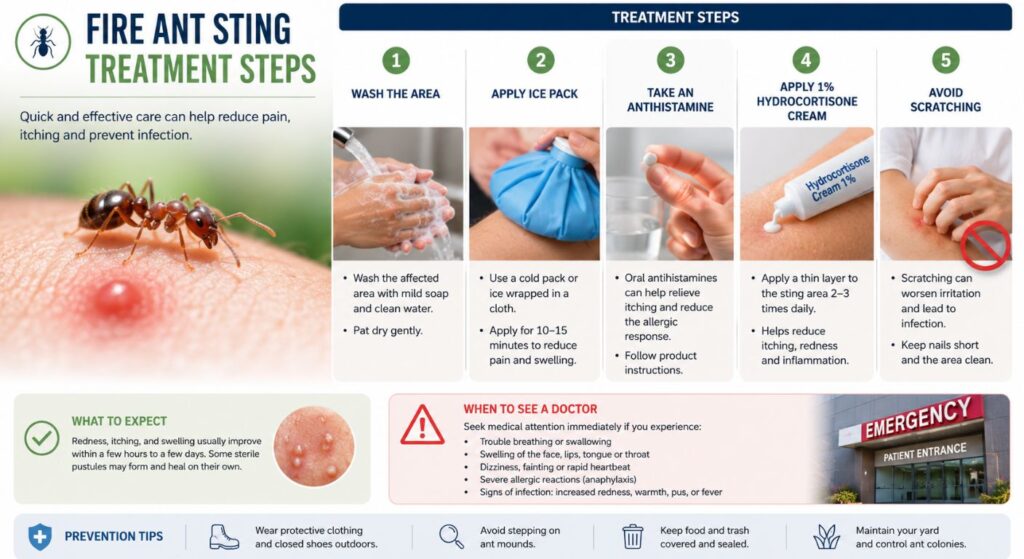
For most healthy adults, fire ant stings are painful and uncomfortable but manageable at home. Kids and elderly people might have stronger reactions. Here’s what actually helps:
Wash the area right away with soap and cold water.
Gets venom residue off the skin and lowers infection risk. Do this as soon as possible because sooner the better.
Ice pack, 10 to 15 minutes.
Ice packs reduce the burning and slow swelling. But don’t put ice directly on your skin. Wrap it in a cloth or towel first.
Antihistamine if you have one.
Benadryl or cetirizine helps with itching and the allergic response. You should take one dose of it.
Hydrocortisone cream on inflamed skin.
1% hydrocortisone calms redness and irritation around the sting sites. There is no prescription needed for this.
Don’t scratch the pustules.
Seriously scratching breaks them open and infection risk goes up a lot. More hydrocortisone cream or antihistamines if the itch is unbearable.
Emergency care for severe symptoms.
If you feel difficulty in breathing, hives spreading beyond the sting area, throat tightness, dizziness so don’t wait. Immediately call 108.
The Fastest Way to Actually Get Rid of Fire Ants
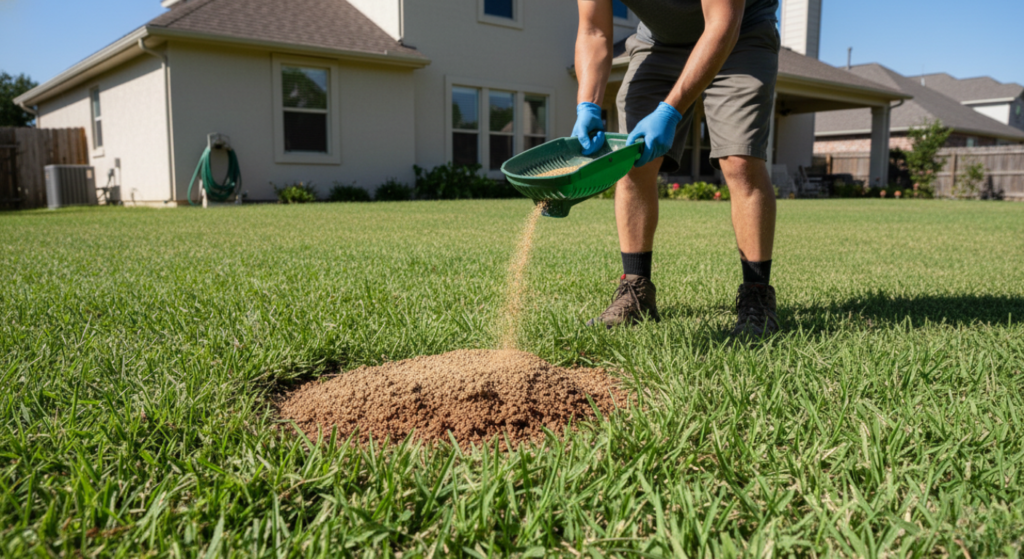
The fastest-acting ant treatments employ two methods: watering the mound and spreading granular bait throughout the yard. Directly treating the mound quickly eliminates visible colonies, while bait eliminates hidden colonies and queens. Professional-grade treatments often reduce activity within 24 to 72 hours.
If you have children at home or you are having a small party in your backyard, you can quickly remove the fire ant mound using the method given below. Speed matters but only if you’re doing the right thing. My neighbour wastes time and money on products that kill surface ants and leave the whole colony completely intact underground. Lots of people do this. The fastest real result comes from two things happening at once.
First, apply something containing bifenthrin, fipronil, or permethrin to the mound for a quick kill. This eliminates visible colony activity within 24 to 48 hours. Second, spread bait throughout the lawn to reach hidden colonies and poison the queens. Products containing hydramethylnon or indoxacarb work best here. They work slowly so that worker ants can carry the bait to the queen ants.
Timing matters too. Apply bait in late afternoon when fire ants are actively foraging. Don’t apply right before rain, it washes away. And don’t water the lawn immediately after broadcasting bait.
Complete 6-Step Fire Ant Elimination Protocol
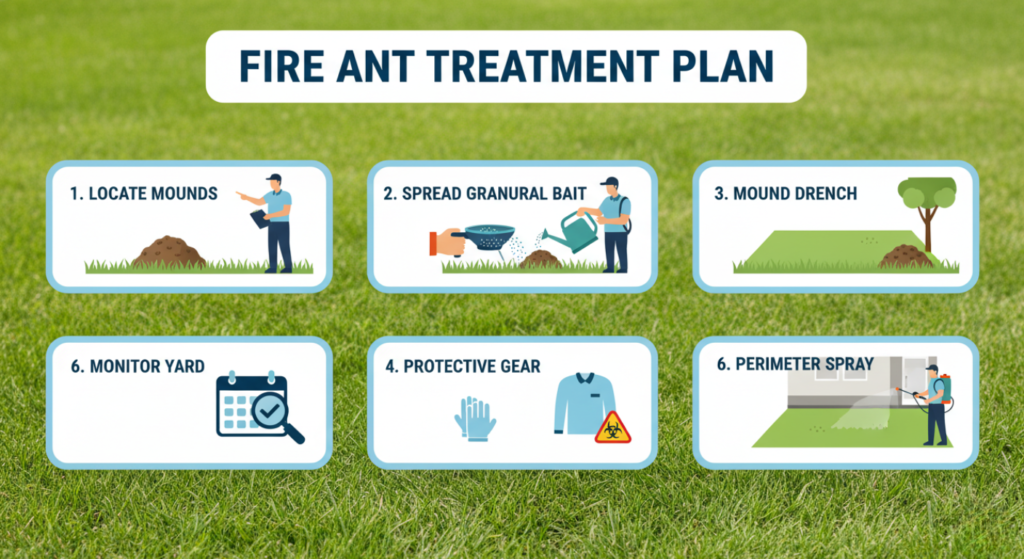
I learned pretty quickly that smashing the mound itself doesn’t really solve anything. If the queen survives underground, the whole colony just comes back again. Baiting combined with targeted mound treatment gives the best result. To treat this you will need –
- Bait spreader or hand spreader
- Granular fire ant bait fresh, not expired
- Protective gloves
- Long sleeves, pants, and closed-toe boots not optional
- Watering can or garden hose
- Insecticidal mound drench product
- Perimeter spray for the foundation area
Walk the entire yard and find every active mound.
During warm weather when colonies are active, mid-morning or late afternoon, it works well. Mark each mound. Check near fence lines, garden beds, under decorative rocks, around AC units, and near the foundation. Hidden mounds are easy to miss so check properly.
Spread granular bait across the whole lawn.
This is the step that I skipped and most homeowners skip this and it’s also the most important one. Hidden colonies that have not built visible mounds yet are still active underground, and broadcast bait is what reaches them. So spread bait everywhere, not just near mounds. Check the expiration date. Old bait doesn’t work nearly as well because the oil-based attractant breaks down over time.
Treat each visible mound individually.
Prepare a liquid mound drench mix. Follow the instructions on the label to make the mix. Pour 1 to 2 gallons slowly around and into the mound. You can also use insecticidal dust. This will kill any existing visible colonies.
Don’t disturb any mounds before treatment.
When I saw this mound in my lawn, I used a dry stick to shake it. And that was my mistake. Shaking a mound before treating it is the biggest mistake. The colony senses danger and moves to another location within hours. Treat first, then the mound is naturally shaken as part of the treatment process.
Keep kids and pets away from treated areas until fully dry.
Every product is different, check the label for specific re-entry times. As a general rule, wait until the lawn is completely dry before letting children or pets back outside.
Monitor for 4 to 6 weeks and re-treat new mounds fast.
There are specific weather conditions for new mound formation, such as after rain, during temperature changes, or when neighboring colonies enter the treated area. Check weekly. Any new mounds that appear immediately receive a direct mound treatment will disappear. For extra precautions, use broadcast bait after 4 weeks. This significantly improves long-term results.
Best Fire Ant Treatments – What Actually Works
The reason granular bait works so well is simple: the worker ants do the hard part for you. They carry the poison straight back underground to the queen. I made this mistake too, early on. I bought a repellent spray, used it around the mounds, and thought the problem was gone because the ants disappeared from that spot. But they didn’t die, just moved.
Repellent products cause fire ants to avoid the treated area, which sounds ideal but it backfires completely, because ants won’t pick up repellent bait and carry it back to the queen. Non-repellent products are different. Ants can’t detect them at all. They walk through, pick them up, and bring them underground. That’s exactly what you want. So for broadcast baiting, always use non-repellent, slow-acting formulations. This one thing changed my results completely.
| Treatment | Effectiveness | Kills Queen? | Best For | Examples |
|---|---|---|---|---|
| Granular bait | High | Yes | Whole-yard control | Amdro, Spectracide |
| Gel bait | Medium | Partial | Small or indoor infestations | Advion Ant Gel |
| Mound drench (liquid) | High | Sometimes | Fast visible mound knockdown | Ortho Fire Ant Killer |
| Insecticidal dust | Medium | Partial | Deep mound penetration | Delta Dust |
| Boiling water | Medium | Rarely | Very small isolated mounds | DIY |
| Diatomaceous earth | Low | No | Supplemental barrier only | Food-grade DE |
| Essential oils | Very low | No | Temporary repellent | Peppermint oil |
Which Fire Ant Bait Should You Use?
Different fire ant situations require different bait strategies depending on colony size, location, and safety needs. Oil-based and protein-based granular baits outperform sugar-based options in most outdoor environments. Not all baits are the same and picking the right one for your situation actually matters. Here’s a quick guide:
- A few small mounds, nothing major – Amdro granular bait applied around visible mounds
- Multiple large colonies spread across the yard – Broadcast bait plus direct mound drench
- Kids or pets using the yard regularly– Enclosed outdoor bait stations
- Fire ants inside the house– Gel bait near entry points indoors
- Want to avoid synthetic chemicals– Spinosad-based bait (derived from natural bacteria)
- Tried multiple treatments and still recurring – Time to call a professional
Natural Ways to Get Rid of Fire Ants – As Per Personal Experience
Most natural fire ant remedies only temporarily repel worker ants. They do not eliminate queen ants. Boiling water and borax baits are still effective for small infestations, providing a slight reduction. However, if you have a large fire ant colony, commercial baits are always needed to completely eliminate it.
You Google it and find vinegar, cinnamon, orange peels, coffee grounds all promised to work. Honestly? Fire ants have been spreading across the southern U.S. for 90 years. If coffee grounds could stop them, there’d be no pest control industry. That said, some natural approaches do have limited usefulness in specific situations. Worth knowing what they actually are good for.
Boiling Water – Works Sometimes
Pouring boiling water into the mound can kill many worker ants and, if it reaches deep and hot enough, can sometimes even kill the queen. Research by Texas A&M Extension suggests its success rate is about 60%, meaning there’s a 40% chance the colony will survive. It’s also dangerous to carry and pour, damaging grass and soil, and rarely reaching deep enough to reach the queen. For a small, isolated mound in bare soil, this is a good option.
Borax Bait – Better for Indoors
A borax-sugar-water mixture works on a similar principle to commercial bait. It’s more useful for indoor ant control than outdoor fire ants. Outdoor bait degrades quickly in heat and weather, and fire ant colonies are usually too large and deep underground for borax to make much of a dent.
Diatomaceous Earth – Supplemental Only
Food-grade DE physically damages the exoskeletons of insects. It works in a similar way, but only in dry conditions. Rain, morning dew, or irrigation will cause it to lose its effectiveness. Use it around door frames or in enclosed spaces as an additional barrier. It does not work as a primary outdoor treatment.
Essential Oils – Short-Term Repellent at Best
Peppermint, citrus, and clove oil disrupt the chemical trails fire ants follow. Ants don’t like the smell of these repellents. The effect lasts a few hours at most. It may redirect ants temporarily. It will not eliminate a colony.
Beneficial Nematodes
Beneficial nematodes are microscopic organisms that parasitize soil insects. Mixed results in research for fire ants specifically work better in consistently moist, loose soil and aren’t reliable as a standalone treatment. It can be part of an integrated approach but don’t rely on them alone.
Fire Ants in the House – What to Do
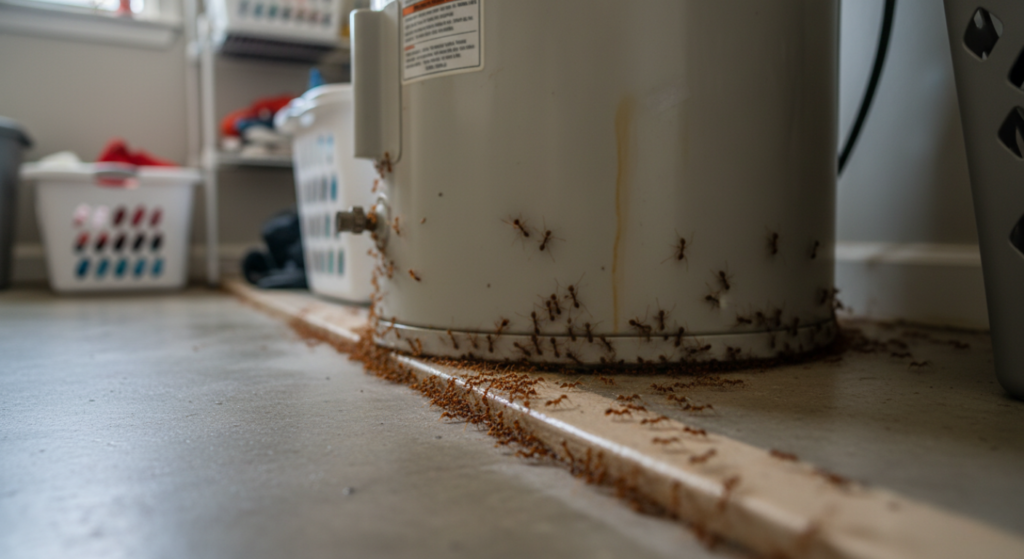
Indoor fire ants almost always indicate an outdoor colony nesting near the structure or recent weather disruption. Fire ants inside homes search for water, grease, or sugary foods. Indoor infestations require both indoor baiting and outdoor colony elimination.
In the last rainy season, there was a storm overnight. When I woke up the next morning, fire ants were crawling on the laundry room floor, near the sink, and near the water heater. The heavy rain forced the fire ant colony inside the house in search of dry ground. It was disturbing to see this. If you are facing a similar situation, it can be fixed; you just need to treat both the inside and outside of the house at the same time. Treating only the inside will not fix it. More ants will keep coming from the outside colony.
For indoor treatment, use gel bait near ant trails and entry points. Don’t spray insecticide on indoor ant trails, it scatters them and makes it harder to trace back to the source. Gel bait lets workers carry the product back to the colony.
Where to Check Inside
- Kitchen – near sink, under appliances, along baseboards
- Laundry room – near washing machine water connections
- Bathrooms – under the sink, near pipes
- Around the water heater
- Near pet food and water bowls
- Wall voids near the foundation after rain
Seal every crack, gap, and opening you find with caulk foundation, baseboards, window frames, door frames. Fire ants can squeeze through surprisingly small gaps. And treat the outdoor colony at the same time using the full protocol.
Fire Ants in the Yard – Where to Look
Sunny lawns and open soil make a perfect place for fire ant mounds. Fire ants often make their homes near sidewalks, gardens, fences, and driveways. It’s important to thoroughly treat the entire yard because many hidden colonies exist outside the visible mounds.
Most people often fall into this trap, thinking that what they see is all there is. But that’s not the case at all. Visible mounds are active, established colonies. But there are also new colonies underground that haven’t yet built mounds.
If you only treat the visible mounds, within a few weeks, those hidden mounds will become your next problem. After treating, check these spots every week. Any new mound that appears gets direct treatment immediately, don’t let it grow.
Most Common Spots in the Yard
- Open, sunny lawn areas
- Along sidewalks and driveways
- Near air conditioning units
- Along fence lines
- Around mailboxes and utility boxes
- At the base of trees and stumps
- Inside garden beds
- Near playground equipment or outdoor furniture
Why Fire Ants Keep Coming Back
Recurrent fire ant infestations occur when queen ants survive the initial treatment or when neighboring colonies migrate to untreated areas. Rain, irrigation, and seasonal heat accelerate fire ant movement and reproduction. Treating only visible mounds rarely resolves a complete infestation.
When I encountered this problem, I treated one mound, and it disappeared, solving the problem. Then, a month later, new mounds appeared all over the lawn. When I investigated more closely, I realized that this wasn’t the same colony returning. It was moving in after seeing the open spaces of neighboring colonies. And these were new colonies.
Fire ants are territorial. When an established colony gets eliminated, other nearby colonies move into that space. This is why one-time treatments rarely stick and why ongoing monitoring matters. Maintaining control means treating twice a year early spring and late summer, regardless of whether you currently see mounds. In high-activity areas like Gulf Coast states, quarterly treatment works better.
Main Reasons Fire Ants Keep Returning
- Only surface ants were killed, queen survived underground
- No broadcast bait used, so hidden colonies were never reached
- Neighboring untreated properties keep sending new colonies
- Rain washed away the bait before fire ants could collect it
- Bait was expired or stored in heat ants ignored it
- Mounds were disturbed before treatment, colony relocated and split
- Seasonal swarm activity during warm months
Mistakes That Make Fire Ant Problems Worse
I too have made mistakes during treatment, you should not repeat these mistakes otherwise the situation will get worse.
- Disturbing fire ant mounds before treatment causes colonies to relocate and split.
- Using gasoline, bleach, or improvised chemicals is dangerous and rarely kills queens.
- Treating only one mound leaves nearby colonies untouched.
Someone online said pour gasoline on the mound. The mound disappeared for two days. Then five new smaller mounds showed up in different spots around the yard. The colony relocated and split. More problems than before.
The gasoline thing is worth addressing directly because it still gets recommended online. It’s dangerous (flammability, fumes, groundwater contamination), it damages soil and nearby plants, and it almost never reaches deep enough to kill the queen. It’s also illegal in many areas. Don’t do it.
Things to Avoid
- Kicking or shoveling mounds before treating the colony will relocate
- Pouring gasoline, bleach, or ammonia into mounds
- Only treating mounds you can see hidden colonies get ignored
- Using expired or heat-damaged bait
- Applying bait right before rain
- Watering the lawn immediately after broadcast bait application
- Stopping treatment too early before the queen is confirmed dead
- Spraying repellent insecticide near bait ants won’t pick up the bait
Pet and Child Safety Around Fire Ant Treatments
Fire ant bait and mound treatments are poisonous. They can be fatal if ingested by children or pets. Treated areas should be kept away from animals until the product has completely dried. Special care is needed where children or pets play outside, as fire ant stings can cause serious injury to young children and small animals.
Before applying anything in the yard, read the product label completely. Every product has different re-entry requirements. Some need 30 minutes, others a few hours. Never assume something is safe just because it’s sold for outdoor use. For yards where pets spend a lot of time, spinosad-based baits are generally considered lower risk than synthetic chemical options. Confirm with your vet if you have specific concerns.
Key Safety Steps
- Read the full label before applying any product
- Keep children and pets away until the treated area is completely dry
- Store all pesticides in original containers, locked away from children
- Wash hands thoroughly after handling any treatment product
- If a child or pet ingests fire ant treatment call Poison Control.
- Check the yard for active mounds before letting kids play unsupervised
- Teach kids to recognize fire ant mounds and never approach or disturb them
When to Call a Professional
Most fire ant problems can be handled at home with the right products and approach. But there are situations where calling a professional just makes more sense than continuing to fight it yourself. A licensed pest control company has access to professional-grade products not available in retail stores, and they can find colonies you can’t see. Most offer free or low-cost inspections. When you call, ask specifically about their fire ant protocol broadcast baiting, active ingredients, and whether they guarantee retreatment if ants return. Call professional if –
- You’ve treated multiple times and mounds keep returning within a few weeks
- Fire ants are getting inside the house repeatedly despite indoor treatment
- Very large property with widespread activity across multiple zones
- Family member with a severe fire ant sting allergy risk needs to be eliminated fast
- Fire ants nesting in walls, under the slab, or in structural areas
- Young children, elderly residents, or immunocompromised individuals at risk
How to Keep Fire Ants From Coming Back
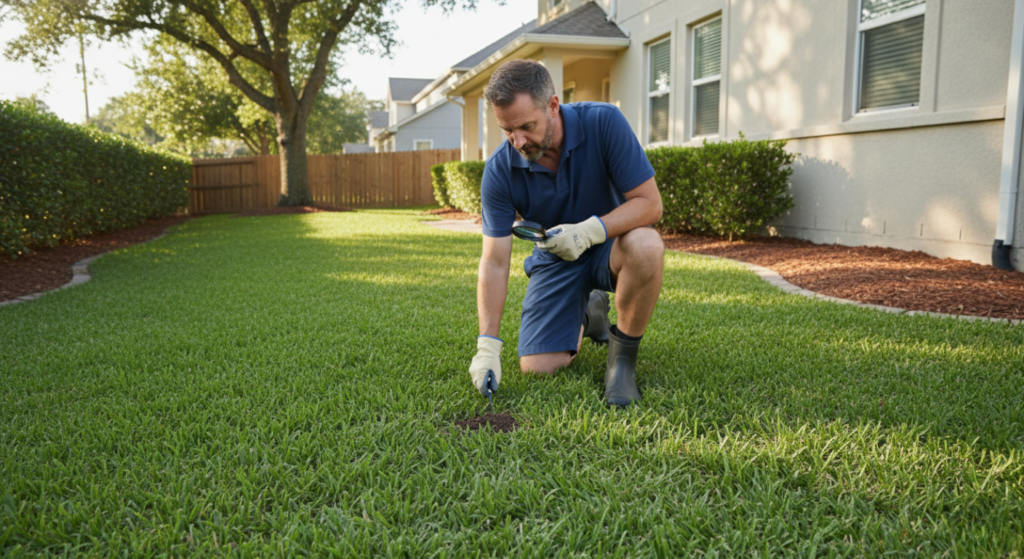
Long-term fire ant prevention requires twice-yearly broadcast bait treatment. Also required removing attractants, and maintaining a dry perimeter around the foundation. High-risk areas need consistent monitoring and proactive treatment after rain.
Honestly, prevention is the part I ignored the longest. I kept thinking, treat it when it shows up, done. But that’s not how fire ants work in warmer states. After two summers of dealing with this, I now keep a simple routine. It takes maybe 20 minutes twice a year and the difference is night and day compared to when I was just reacting every time a new mound appeared.
Seasonal Prevention Routine
- I used to broadcast granular bait in early spring before activity peaks
- Second broadcast application in late summer
- I suggest you to inspect yard for new mounds after every heavy rain and treat immediately
- Maintain a clear dry perimeter around the house no mulch touching foundation walls
- Keep outdoor pet bowls off the ground, bring them in after meals
- I mow regularly because shorter grass is less hospitable to mound building
- I remove yard clutter, wood piles, and debris that create hidden nesting spots
- I used to seal cracks in door frames, window frames, and foundation with caulk.
Frequently Asked Questions
Will fire ants go away on their own?
No. Fire ant colonies do not naturally die out or move on without a reason. They grow larger over time, producing new queens, and forming new satellite colonies nearby. A colony of 50,000 ants today can grow to 200,000+ by the end of the season.
What kills fire ants instantly?
Contact insecticides with bifenthrin, permethrin, or deltamethrin kill individual ants on contact very fast. Boiling water also works instantly on contact.
Do fire ants bite or sting?
Both. The ant bites to capture prey, then stings repeatedly. The bites are not noticeable, but the stings cause a sharp burning sensation and a white rash the next day.
Are fire ants dangerous to dogs and cats?
Yes, especially small animals and young pets. Fire ants can attack dogs or other pets rapidly, as pets tend to disturb the nest. Symptoms of fire ant stings in pets include excessive scratching, licking, pawing at the face, and swelling. If there are too many ants, breathing problems may occur. In such cases, contact your vet.
Why do fire ant mounds appear overnight after rain?
When rain saturates the ground, underground tunnels flood and the colony moves upward and outward to find dry soil. That’s why a yard that looks clear can suddenly have multiple mounds. This one I saw with my own eyes after that week of rain. Woke up and counted three new mounds.
How long does fire ant treatment take to work?
Mound drenches show visible results within 24 to 48 hours. Granular bait takes longer typically 1 to 6 weeks because it works by being slowly carried back to the queen. The slower the kill, the more effective the bait tends to be. Honestly the waiting part is the hardest. You apply the bait and then nothing looks different for two weeks. Stick with it.
Can fire ants survive winter?
In Gulf Coast states like Texas, Florida, Louisiana, and Georgia, fire ants stay active year-round. In colder climates, colonies move deeper underground during the winter, and their activity increases with the arrival of spring. They do not die off in the winter.