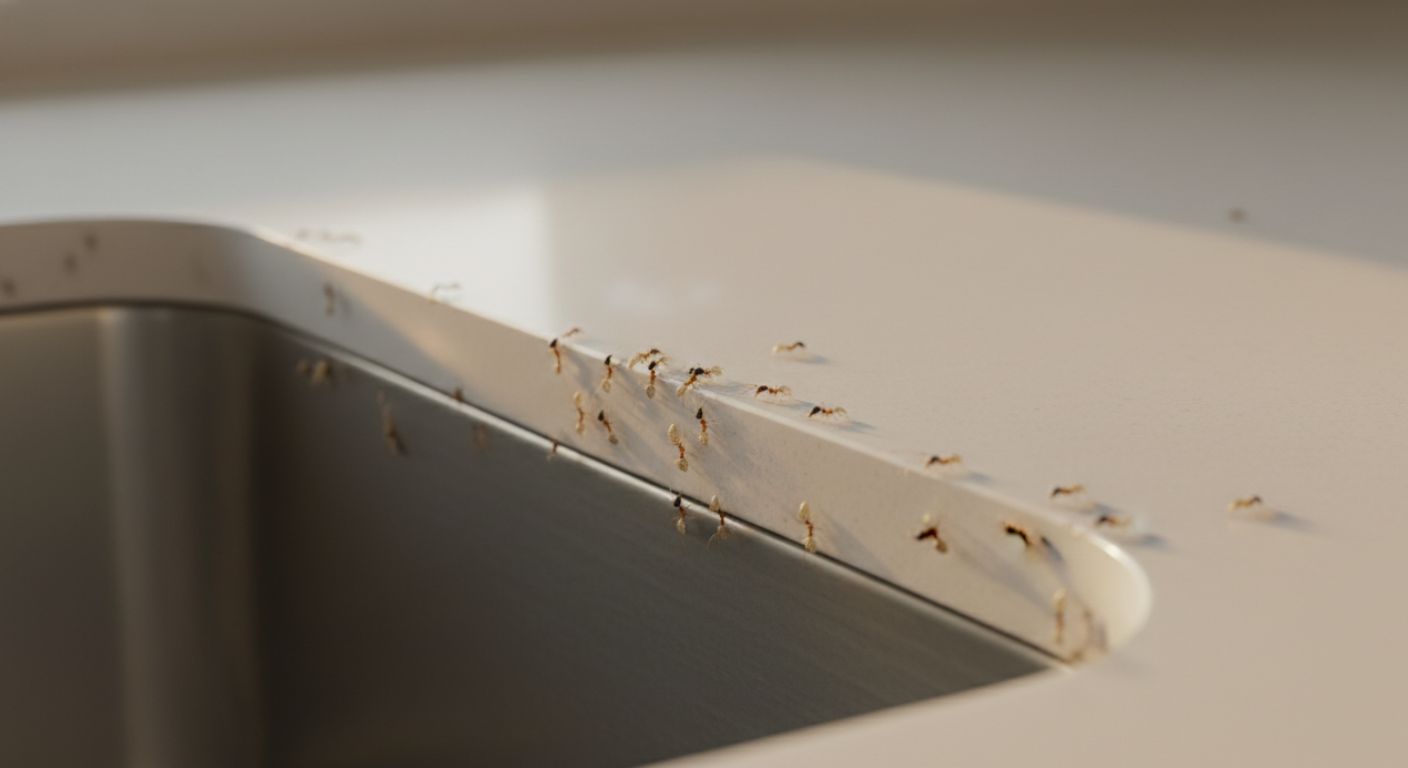
I wiped down the kitchen counter before bed. Everything looked clean like no crumbs, no spills. But the next morning when I walked in, I was shocked. Dozens of tiny pale ants crawl around the coffee maker and near the sugar jar. Trailing along the edge of the sink like they own the place.
At first I wondered if they’re even ants. Then I look closer and there are hundreds of them materializing from somewhere invisible. So small, so pale. After research I found, this is a ghost ant infestation. And honestly, it’s one of the more frustrating household pest problems. And most people handle it the wrong way and end up making things significantly worse, and I did it too.
But the good thing is that once you understand how ghost ant colonies actually work, controlling them is not complicated. This blog walks through everything- what ghost ants are, why they showed up, and exactly how to get rid of them for good without making the classic mistakes that spread them further into your home.
Quick Answer – How to Get Rid of Ghost Ants
- Ghost ants are eliminated using slow-acting sweet liquid bait placed directly on active trails.
- Ghost ant colonies require complete queen elimination because spraying visible worker ants causes colony budding and spread.
- Most ghost ant infestations improve within 5 to 14 days after proper baiting and sanitation.
In short, stop spraying them. Place liquid bait directly on the trails and leave it alone for 1–2 weeks. Fix any moisture problems in the kitchen and bathrooms. That combination handles the vast majority of ghost ant problems without professional help. Everything below explains the reasoning, the right products, and the common mistakes to avoid.
What Are Ghost Ants?
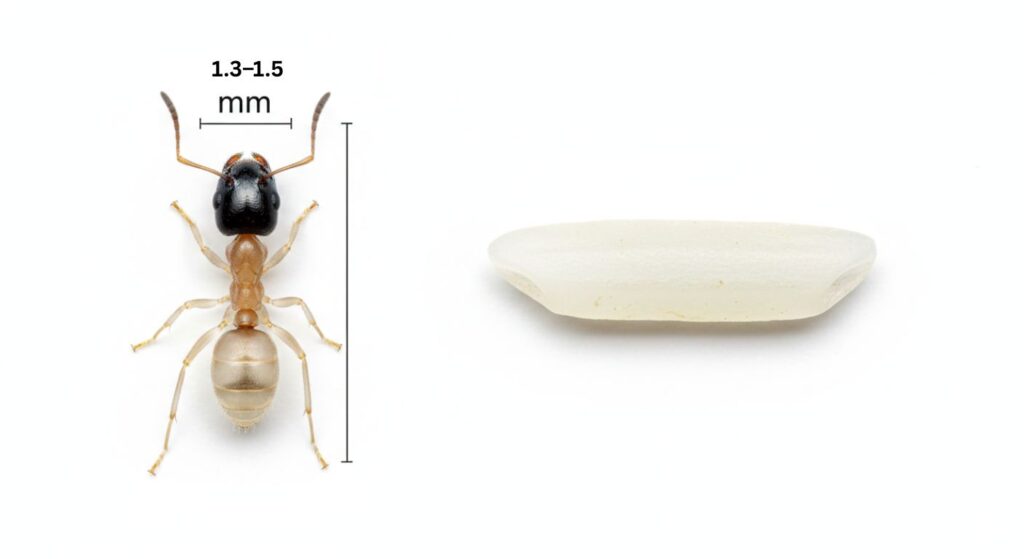
Ghost ants are small tropical ants. Their heads are black, and their legs and abdomen are almost transparent. Ghost ants measure approximately 1.3–1.5 mm in length. Ghost ants are one of the smallest house ants. Ghost ant colonies usually nest indoors near moisture and warmth.
One morning, when I went to the kitchen, I was stunned to see these strange ants wandering around. The body was invisible, and the head was completely black. And as soon as I went into the dim light, it seemed as if these ants disappeared.
The scientific name of ghost ants is Tapinoma melanocephalum. Originally from the tropics, these ants have spread across the southern United States, Hawaii, and warm coastal regions worldwide. Ghost ants like humid environments. The “ghost” part comes from the body. The abdomen and legs are almost translucent, a pale yellowish-white that makes them genuinely hard to spot against light-colored countertops or floors. The head is darker, almost black or dark brown.
For scale, that’s smaller than a grain of rice. Ghost ants move fast, in narrow trails, and establish pheromone paths quickly once a food source is found. These ants commonly invade kitchens, bathrooms, potted plants, wall voids, and cabinets any spot that offers warmth, moisture, and proximity to food. According to University of Florida IFAS Extension, ghost ants are a significant indoor pest in warm, humid climates.
Ghost Ant Quick Identification :
| Feature | Ghost Ants |
| Size | 1.3–1.5 mm |
| Color | Dark head + pale translucent body |
| Speed | Fast-moving |
| Nesting | Indoors near moisture |
| Diet | Sugars and sweets |
| Bite/Sting | No sting, rarely bite |
| Common Locations | Kitchens, bathrooms, walls |
Why Ghost Ants Are in Your House
Ghost ants enter homes searching for sugar, moisture, warmth, and protected nesting sites. Kitchen residue, leaking pipes, humidity, and indoor plants commonly attract ghost ant colonies. Ghost ants can enter through cracks smaller than 1 mm.
When I had an infestation at my house, I thought my kitchen was clean, but for several days now, I’ve been seeing ghost ants around the coffee maker every morning. When I went in detail, I found that a very small piece of sugar was stuck in the countertop line, which was enough to attract worker scouts.
This is the part that confuses most people. The kitchen looks clean. The bathroom gets scrubbed regularly. But ghost ants keep showing up. Why?
Because ‘clean’ to human eyes and ‘clean’ to an ant are completely different things. A tiny smear near the coffee maker spouts. A faint sticky ring where the syrup bottle sat. The invisible residue in a cabinet hinge after a juice spill two months ago. Ghost ant workers can detect sugar concentrations that no human nose would ever notice.
Moisture is the other major reason. Ghost ants need humidity along with the food to survive. Bathrooms, spaces under sinks, areas around dishwashers and plumbing create the microclimate ghost ant colonies prefer for nesting. As University of Florida IFAS Extension notes, ghost ants are a tropical species that need warm, moist conditions which is exactly what most modern homes provide year-round.
Common Causes and Fixes:
| Cause | What Happens | Fix |
| Sugar residue | Attracts foraging workers | Clean surfaces daily |
| Leaking pipes | Creates moisture source | Repair leaks immediately |
| Humid bathrooms | Supports nesting | Improve ventilation |
| Open food containers | Sustained feeding source | Use airtight storage |
| Indoor plants | Nesting location | Reduce overwatering |
| Wall cracks | Colony access point | Seal gaps after treatment |
Signs of a Ghost Ant Infestation
Visible trails of tiny pale ants near sweet foods are the most common sign of ghost ant activity. Ghost ant infestations appear around sinks, countertops, bathroom vanities, and electronics. Repeated indoor trails usually indicate multiple hidden nests.
Ghost ant infestations often sneak up on people. My neighbour notices one or two tiny pale ants and figures it’s nothing. A few days later, the trail is obvious and clearly organized. That’s how they work: scout ants find food, lay a pheromone path, and workers follow in large numbers once the signal is established.
Tiny Fast-Moving Ant Trails
Ghost ant workers move fast in narrow trails while searching for sweet food sources. Ghost ant trails commonly follow edges, wires, plumbing lines, and cabinet corners. Night activity is often heavier than daytime, so checking after dark with a flashlight sometimes reveals trails you’d never notice during the day.
Ants Around Moisture
Ghost ants strongly prefer humid nesting conditions and gather near water sources. Bathrooms and kitchen sinks are common ghost ant hotspots. Finding ghost ants near the bathroom faucet, around the shower base, or under the kitchen sink isn’t random.
Those locations often have small moisture buildups – condensation, slow drips, humidity from daily use that make ideal nesting spots. If you’re seeing ants in the kitchen and bathroom, there will be a high chance that they are operating colonies through shared wall space.
Ants Near Electronics
Ghost ants sometimes nest inside warm electronics and electrical outlets because heat supports colony survival. Indoor electronics provide protected nesting cavities. One of my friends was surprised when he found nesting inside routers, coffee makers, microwaves, and outlet boxes. The heat from electronics is like tropical temperatures, which ants love. They also feel safe in the enclosed space.
Recurring Indoor Trails
If you repeatedly see ghost ant tracks, it’s often a sign that the colony has budded and established multiple satellite nests. Spraying the visible ants usually only increases the spread inside the house.
If you’ve cleared the path and treated the area where the ants were, but still see ghost ants again in a slightly different location within a few days, this is a sure sign of budded satellite nests. Ghost ant colonies are easily disrupted. Disturbance causes queens to migrate with their workers to other locations and establish new nests in different parts of the structure.
Where Ghost Ants Nest
This is tough to understand. Ghost ant nests are almost never where you can see them. The ants you see walking across the counter are workers foraging out from a hidden nest. The nest itself is tucked into a wall void, under a cabinet base, inside a planter, behind an appliance, or somewhere equally inaccessible.
Common indoor nesting sites: wall voids, under sinks, bathroom cabinets, behind kitchen backsplashes, potted plants, behind appliances, electrical outlets, and window frames.
Outdoors, ghost ants nest under rocks, in mulch beds, under debris near the foundation, and in soil cracks. Outdoor nests often serve as the source population for indoor foraging which is why sealing entry points matters as part of long-term prevention.
How to Get Rid of Ghost Ants 6-Step Removal Protocol
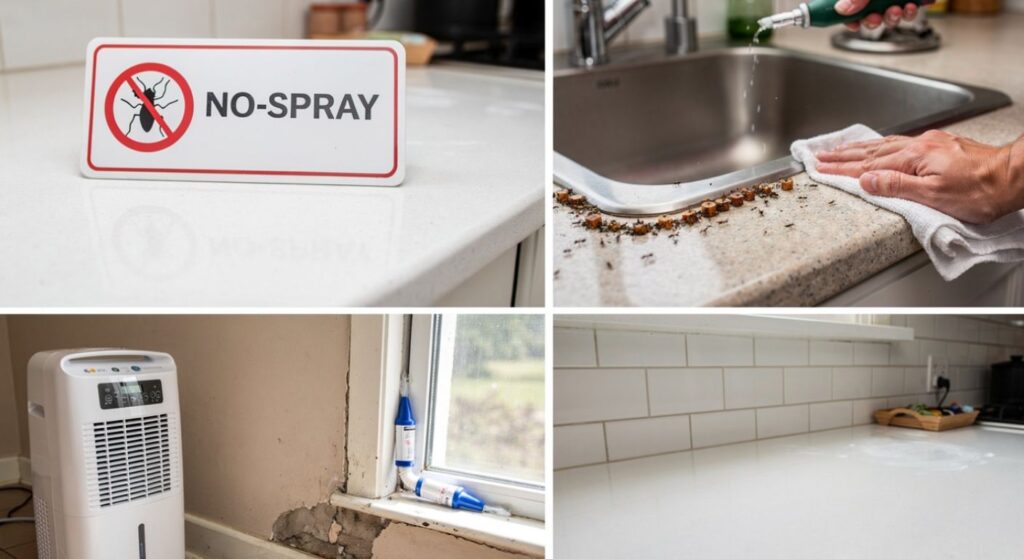
Permanently eliminating ghost ants need slow-acting baits, cleaning, and colony elimination. Repellent sprays disperse ghost ant colonies into multiple satellite nests. Applying the correct bait directly to active routes is most successful.
I sprayed the ants near the sink in my kitchen, and it seemed as if they had disappeared for a day. The next morning, ghost ants appeared in the bathroom and pantry because the colony, sensing the danger of the chemicals, had dispersed into new nests.
Before the steps, here’s what you’ll need:
- liquid ant bait
- gel bait (for tight spaces)
- a flashlight
- silicone caulk
- cotton swabs
- white vinegar in a spray bottle
- gloves
- paper towels
Total cost for a complete DIY treatment is usually well under what a single professional visit would run.
- Stop spraying visible ghost ants immediately.
This is the most important step. Repellent sprays trigger budding in the colony. This is a biological response. This causes the queen and workers to disperse into multiple new nests. Every time you spray, you’re somehow exacerbating the problem.
- Find active trails using a flashlight.
Check countertop edges, cabinet corners, baseboards, plumbing gaps, and wall seams. Mark areas where you see frequent ant activity, place bait there.
- Place sweet liquid bait directly on active trails.
Don’t clear the paths immediately after placing the bait. This will allow worker ants to easily find the bait, pick it up, and carry it back to the hidden queens. Terro Liquid Ant Baits and Advion Ant Gel are two of the most reliable products specifically for ghost ants.
- Remove competing food and sugar sources.
Store everything in airtight containers. Wipe down sticky surfaces, coffee station areas, pet food bowls, and trash bin lids. If workers have better food options nearby, they may ignore bait.
- Reduce indoor moisture.
Fix dripping faucets, dry under-sink cabinets, improve bathroom ventilation, address any plumbing leaks. Eliminating humidity removes the nesting conditions that make ghost ant colonies sustainable indoors.
- Seal entry points
Do this only after activity has dropped significantly. Caulking cracks and gaps prematurely can trap live colonies inside walls, which causes them to forage more aggressively. Seal after 2–3 weeks of declining activity.
Best Ghost Ant Treatments – Product Comparison
Sweet liquid bait and gel bait are the most effective ghost ant treatments because worker ants transfer poison throughout the colony. Contact sprays only kill visible ants and rarely eliminate queens. Combination baiting and sanitation provide the best long-term control.
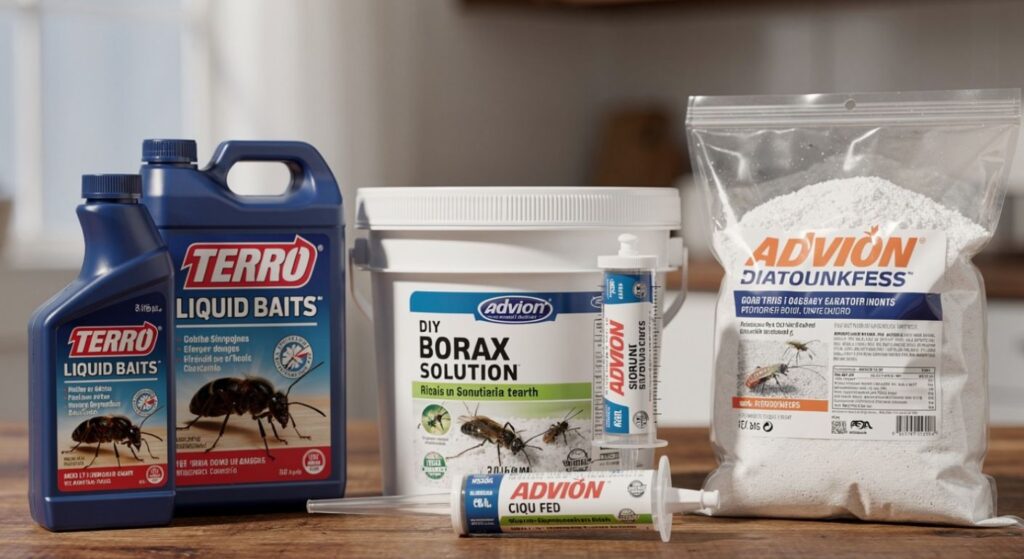
| Treatment | Effectiveness | Kills Colony? | Best For | Recommended Product |
| Liquid bait | High | Yes | Indoor trails | Terro Liquid Ant Baits |
| Gel bait | High | Yes | Tight spaces | Advion Ant Gel |
| Borax DIY bait | Medium – High | Yes | Budget option | Homemade borax mix |
| Vinegar spray | Low | No | Trail cleanup only | White vinegar |
| Essential oils | Low | No | Temporary deterrent | Peppermint oil |
| Aerosol spray | Low | No | Visible kill only | NOT recommended |
Best Bait for Ghost Ants
Ghost ants prefer sweet liquid bait because ghost ant workers feed heavily on sugars and honeydew-like substances. Slow-acting bait allows worker ants to transfer poison deep into hidden nests.
The slow-acting part is what makes liquid bait work. Products like Terro use borax at a concentration low enough that worker ants survive long enough to return to the nest and share the bait with nestmates including queens. Kill the workers too fast and the bait never reaches the colony core.
Placement matters more. Put bait stations at sink edges, cabinet corners, along active trail paths, and in bathroom vanity areas. Don’t place them in the middle of the floor where ants aren’t trailing. Put them exactly where workers are already moving.
One critical rule is never spray near bait stations. The chemical from sprays repels ants and breaks down pheromone trails, meaning workers won’t find your bait and you will not get any positive result.
Natural Ways to Get Rid of Ghost Ants
Borax bait is the only natural remedy capable of eliminating ghost ant colonies. Essential oils and vinegar temporarily disrupt trails but do not kill queens. Natural deterrents work best as supplemental prevention after colony elimination.
As per my personal experience, online tips promise instant results with cinnamon, lemon juice, or tea tree oil but ghost ants simply reroute around most surface repellents within hours.
You can easily find a lot of “natural ant killer” content online, which offers remedies, but they don’t specify how effective they are. Essential oils and cinnamon can temporarily block ant paths, and they can sometimes be useful during cleaning, but none of these reach hidden colonies or harm queen ants. For this, you need something that will be returned by worker ants. I’ll tell you about these in the next section.
Borax Bait (Most Effective Natural Option)
Borax-based bait is genuinely effective when made at the right concentration. Too much borax and you kill workers before they reach the nest. The standard mix is 3 parts sugar to 1 part borax, dissolved in just enough warm water to make a thick syrup. Apply with cotton swabs near active trails. Refresh every 2-3 days. It works slowly but gives amazing results.
This is essentially what commercial liquid baits like Terro already contain: borax is the active ingredient. The DIY version works, but commercial formulations are more precisely calibrated.
Vinegar Spray
It’s useful for cleanup after the infestation is under control. Vinegar destroys ghost ant scent trails temporarily. Vinegar does not eliminate hidden nests. Wiping down trails with diluted white vinegar removes pheromone markers and slows re-establishment of foraging paths. Avoid the use of it during active treatment disrupting trails while baiting is in progress and reduces bait uptake.
Diatomaceous Earth
Food-grade diatomaceous earth can be useful in very dry locations like inside dry wall voids, under appliances and in outdoor mulch areas. It works by physically damaging the ant’s exoskeleton, leading to dehydration. In moist environments like bathrooms, under sinks, it loses effectiveness quickly. It is best to be used as a supplemental barrier, not primary treatment.
Ghost Ants in the Kitchen
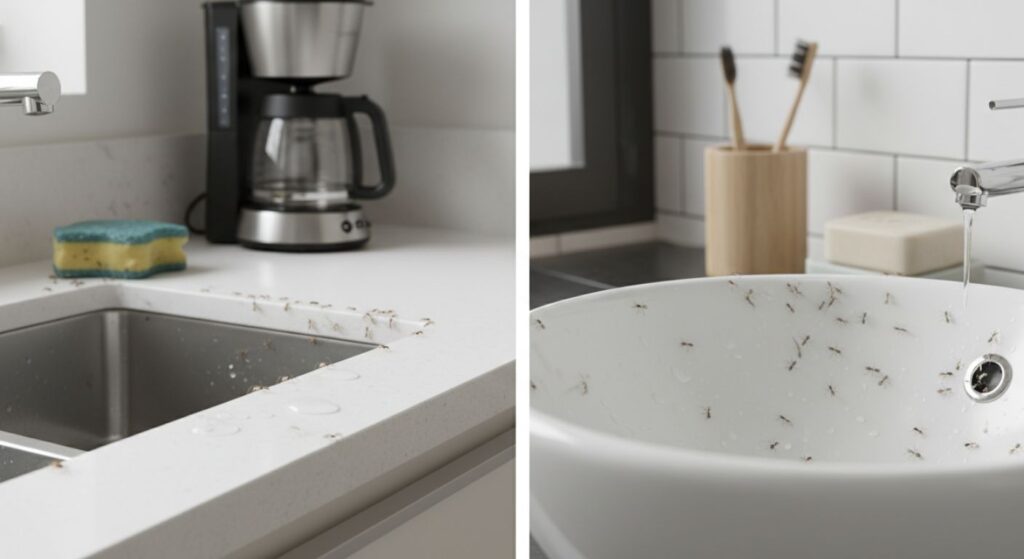
Kitchen ghost ant infestations are usually caused by sugar residue, food crumbs, and moisture. Coffee makers, syrup bottles, sinks, and pet food areas commonly attract ghost ant workers.
The kitchen is the most common location for ghost ant problems, and the coffee station is probably the single most common hotspot within kitchens. Coffee maker drip areas, syrup bottle bottoms, the gap between the counter and backsplash, the hinge area of cabinets – all of these collect sweet residue that can sustain ant foraging indefinitely.
Other common kitchen hotspots are dishwasher door seals, sugar containers especially the bottom, pet food bowls and feeding mats, trash bin lids and sides, and the area around the garbage disposal drain.
Kitchen treatment focus: Bait placement along active trails, deep cleaning of sticky residue, and airtight storage for anything sweet. Don’t forget to check under the dishwasher and behind the refrigerator, ghost ant nests in kitchen appliance gaps are more common than people expect.
Ghost Ants in the Bathroom
Bathroom ghost ants usually indicate moisture-driven nesting activity. Ghost ant colonies develop behind bathroom walls and under sinks because of humidity and plumbing leaks.
When I saw the tiny pale ghost ant in the bathroom, I was thinking why they are here, there is nothing to eat. Then I researched and found infestations are almost always about moisture, not food. These ants aren’t finding sweets in the bathroom, they’re finding the humidity and warmth they need to establish a stable nest. The nests are usually behind bathroom walls, under the vanity cabinet, or in the space around pipe penetrations.
Bathroom treatment approach: place bait near plumbing access points and along any visible trails. Fix any dripping faucets or under-sink leaks immediately. Dry out the vanity cabinet and improve ventilation. A bathroom fan running during and after showers makes a meaningful difference in ambient humidity over time.
If you’re seeing ghost ants in both the kitchen and bathroom simultaneously, run a flashlight along baseboards connecting the two rooms. There’s often a trail running through shared wall space that reveals the connection between what look like two separate infestations.
Why Spraying Ghost Ants Makes Infestations Worse
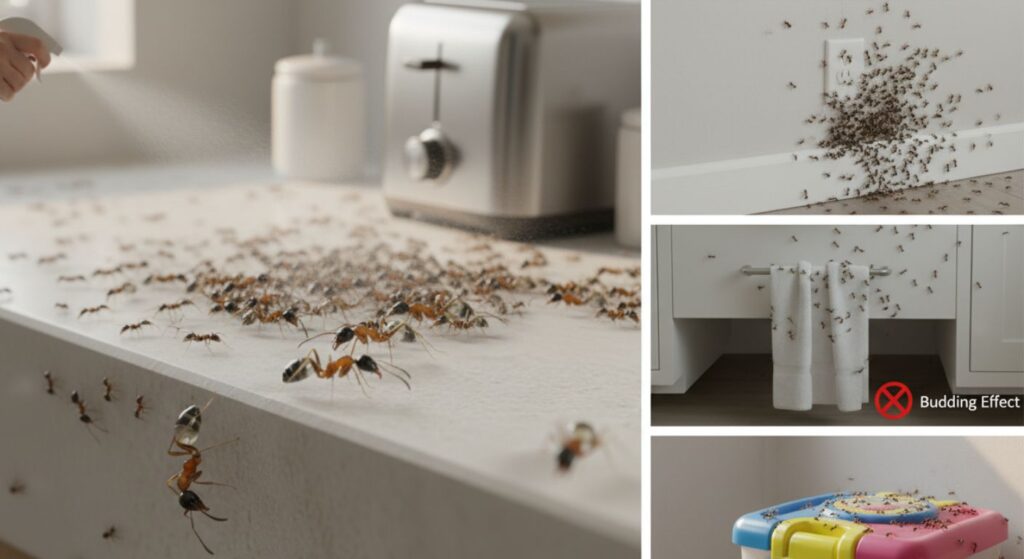
Repellent sprays trigger ghost ant colony budding behavior. Colony budding causes queens and workers to split into multiple new nests throughout the structure. One small infestation can rapidly become several indoor colonies after spraying.
In my case, when I sprayed, ghost ants disappeared from the kitchen for two days and suddenly appeared in bedrooms and bathrooms. The colony didn’t die, it relocated and multiplied. This is probably the most important thing to understand about ghost ants specifically. Colony budding is a survival response unique to certain ant species, ghost ants among the most notable. When a colony senses a chemical threat, it doesn’t fight back. It splits.
Contact-kill sprays only eliminate the workers you can see, never the queens, never the workers deep in the nest. The colony recovers quickly, now potentially more dispersed and harder to treat. This is why Texas A&M AgriLife Extension specifically advises against repellent insecticide sprays for ghost ant control, recommending baiting as the primary strategy.
How Long Does It Take to Get Rid of Ghost Ants?
Most ghost ant infestations improve within 5 to 14 days after proper baiting begins. Large infestations involving multiple satellite colonies may require several weeks of continuous treatment.
Realistic timeline expectations are very helpful here, as many people remove the bait too quickly or take a short-term increase in ant activity as a sign that the bait isn’t working. But the opposite is true. Increased activity means the workers have found the bait and it’s working.
| Infestation Size | DIY Bait Treatment | Professional Treatment |
| Small | 5–7 days | 1–3 days |
| Medium | 1–3 weeks | 5–7 days |
| Large/Budded | 3–6 weeks | 1–2 weeks |
Keep bait fresh and replenish as needed. Don’t clean up or move bait stations while they’re being actively visited. Patience here is genuinely part of the treatment.
Mistakes That Make Ghost Ant Problems Worse
Spraying ghost ants before baiting is the most common treatment mistake. Removing bait too early prevents colony elimination. Ignoring moisture problems allows ghost ant nests to survive indoors.
When I placed bait, I was shocked to see lots of ants. The bait suddenly attracted hundreds of ants, so I threw it away. exactly when the treatment is working best and workers are actively carrying poison back to the colony.
The bait-removal mistake is genuinely one of the most common things that extends ghost ant infestations. A sudden surge in ant activity around a bait station looks alarming. It feels like the bait is drawing more ants to your home. In reality, it means worker ants found the bait, established a strong pheromone trail to it, and are now actively feeding and carrying it back. That’s the treatment working.
Other common mistakes that extend infestations:
- Spraying visible ants triggers colony budding
- Removing or moving bait stations during active feeding
- Cleaning pheromone trails while baiting is in progress
- Leaving food, crumbs, or sticky residue that competes with bait
- Sealing cracks too early can trap active colonies inside walls
- Using borax bait at too-high concentration kills workers before they return to the nest
Pet and Child Safety During Treatment
Ghost ant bait products may become dangerous if ingested in large quantities by pets or children. Enclosed bait stations and hidden placement improve household safety during treatment.
Commercial bait stations like Terro use borax at low concentrations, the same ingredient in many laundry products. A pet licking a bait station occasionally is unlikely to cause serious harm, but it’s better to avoid the situation entirely.
The EPA recommends following all pesticide label instructions carefully around pets and children which for ghost ant baits usually means placing stations in locations inaccessible to small animals and children: behind appliances, under cabinet kick plates, inside cabinet corners, in spaces too narrow for a dog or cat to access easily.
- Place bait behind appliances and inside cabinet corners
- Use enclosed station formats rather than open liquid pools where possible
- Wear gloves during bait handling and placement
- Wash hands after treatment
- Keep pets away from bait placement areas for the first few hours
When to Call a Professional
Professional pest control becomes necessary when ghost ant infestations persist after several weeks of baiting or when colonies spread into multiple rooms. Large apartment and condo infestations often require building-wide treatment.
In my neighborhood, the Ghost ants disappear from the kitchen and reappear in three separate bathrooms because hidden satellite colonies remain active inside shared walls, and DIY bait can only reach foraging workers, not every colony branch.
Most ghost ant problems respond well to DIY baiting within a few weeks. But there are situations where professional treatment is the right call:
- Activity continues after 4 full weeks of consistent baiting
- Ants spread into multiple rooms despite baiting in original location
- Suspected nesting inside walls with no accessible entry points for bait
- Apartment or condo infestations where neighbors may have untreated colonies
- DIY bait fails repeatedly may indicate a large multi-queen colony or severe budding
Professional exterminators have access to non-repellent insecticides that ghost ants carry back to the nest without detecting as a threat a different mechanism from DIY baiting that can penetrate established satellite colonies more effectively. Early professional treatment usually prevents more severe structural infestations later.
How to Prevent Ghost Ants Permanently
Permanent ghost ant prevention need moisture control, sanitation, and sealing access points. Homes without exposed sugars and humidity attract less ghost ant colonies.
Once the infestation is cleared, the focus shifts to making your home less hospitable for future ghost ant colonies. These are habits more than one-time fixes:
- Wipe counters daily especially the coffee station area.
- Store sugar, honey, and syrups in airtight containers.
- Fix plumbing leaks promptly, even slow drips.
- Dry bathroom sinks and vanity areas nightly.
- Run bathroom fans during and after showers.
- Seal wall cracks, gaps around plumbing, and baseboard gaps.
- Reduce indoor humidity during warm months dehumidifiers help in basement areas.
- Clean pet food bowls after feeding and keep feeding area dry
- Check potted plants for overwatering soggy soil is a prime ghost ant nesting site
- Monitor kitchens and bathrooms during spring and summer when ghost ants are most active
Ghost Ants vs Sugar Ants – What’s the Difference?
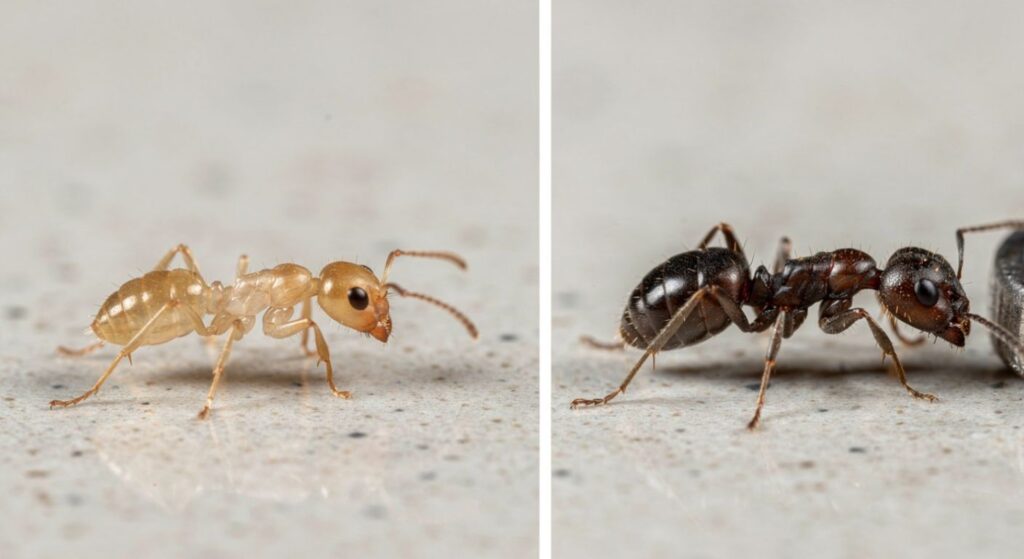
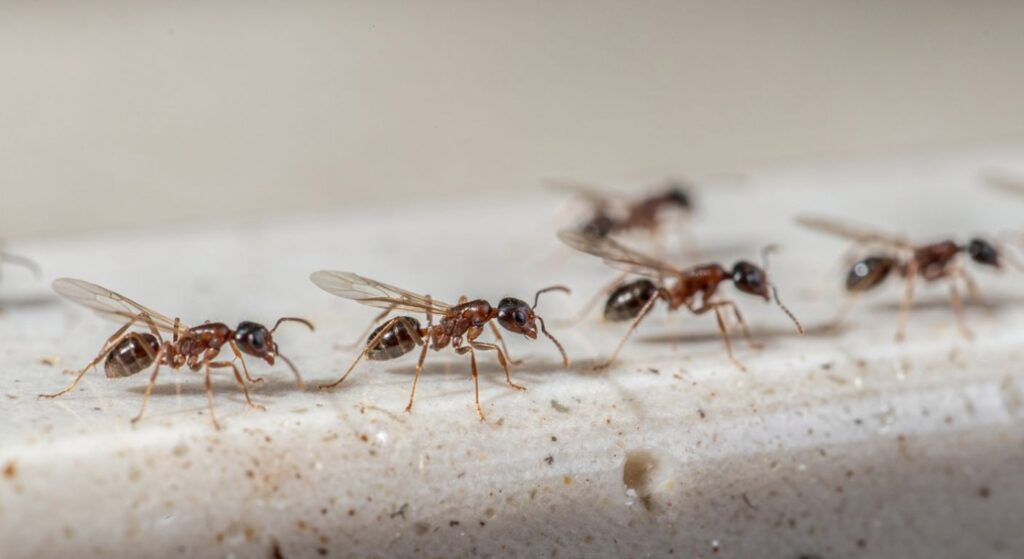
Ghost ants and sugar ants are commonly confused because both species invade kitchens searching for sweets. Ghost ants are much smaller and feature translucent pale bodies, while most sugar ants appear darker and larger.
“Sugar ant” is a catch-all term people use for any small ant drawn to sweet food. In North America it often refers to the odorous house ant darker, slightly larger, and doesn’t have the same translucent body ghost ants have. The treatment approach is similar , but ghost ants specifically carry the colony budding risk that makes spray treatment especially counterproductive.
Quick identification: If the ants are nearly invisible against a light countertop and seem to appear and disappear randomly those are almost certainly ghost ants. Darker, more uniformly visible sweet-seeking ants are more likely odorous house ants or pavement ants.
| Feature | Ghost Ants | Sugar Ants |
| Size | Extremely tiny (1.3–1.5mm) | Small (2–3mm) |
| Color | Pale/translucent body, dark head | Uniform brown or black |
| Nesting | Indoors near moisture | Indoors and outdoors |
| Speed | Very fast | Moderate |
| Key Risk | Colony budding from spraying | Less prone to budding |
Frequently Asked Questions
Why do I suddenly have ghost ants?
Ghost ants appear suddenly when a scout worker finds a food or moisture source and establishes a pheromone trail. Other workers follow that trail in large numbers quickly.
Do ghost ants bite?
Ghost ants technically can bite but almost never do, and they have no stinger. They’re nuisance pests, not a health threat.
What kills ghost ants permanently?
Slow-acting liquid bait is the only reliable method for permanent elimination. The borax in products like Terro travels from worker ants back to queens and nestmates, collapsing the colony from within. Surface sprays cannot achieve this.
Why are ghost ants so hard to kill?
Their size makes nests nearly impossible to locate, and their colony budding behavior means the wrong treatment like spraying actively makes the problem worse.
What is the best bait for ghost ants?
Terro Liquid Ant Baits and Advion Ant Gel are the two most consistently recommended products for ghost ants. Both use slow-acting active ingredients that workers carry back to the colony. Placement on active trails matters as much as product choice.
Are ghost ants dangerous?
No. Ghost ants don’t sting, rarely bite, and don’t cause structural damage. They’re classified as nuisance pests. The concern is food contamination when they forage through kitchen areas.
Why do ghost ants keep coming back?
Usually one of two reasons: untreated satellite colonies that weren’t reached by baiting, or ongoing moisture and food sources that continue attracting new foragers. Recurring infestations almost always mean either the colony wasn’t fully eliminated or the environmental conditions haven’t changed.
Can vinegar kill ghost ants?
No. Vinegar disrupts pheromone trails temporarily and can be useful for cleanup after treatment, but it doesn’t penetrate nests or affect queens. It’s not a colony-elimination tool.
Can ghost ants live inside walls?
Yes, and do. Wall voids near plumbing, bathroom walls with pipe penetrations, and kitchen walls near dishwashers and sinks are all common ghost ant nesting locations. This is why baiting on trails letting workers carry poison back matters more than trying to locate and spray the nest directly.
What attracts ghost ants?
Primarily sugars and sweet residue, and moisture. Even microscopic sweet residue attracts foraging workers. Humidity and warmth attract nesting activity. Homes with leaky plumbing, overwatered plants, humid bathrooms, and exposed food consistently have more ghost ant problems.
Do ghost ants go away on their own?
Outdoor ghost ants may move on seasonally. Indoor ghost ant infestations, where the colony has established nests inside wall voids or under cabinets, almost never resolve without treatment.
Should ghost ants be sprayed?
No, this is the most common mistake we do. Repellent sprays trigger colony budding, causing the colony to fragment into multiple new nests. What looks like it’s working (ants disappearing for a day or two) is actually the infestation spreading into new areas. Baiting is the correct approach for ghost ants specifically.
When should a professional handle ghost ants?
Call a professional if: activity persists after 4 weeks of consistent baiting, ants spread into multiple rooms despite treatment, there’s evidence of large wall-void nesting inaccessible to bait placement, or if you’re in an apartment/condo where neighboring units may be the source.
Are ghost ants worse than other sugar ants?
In terms of indoor spread potential, yes. Ghost ants’ colony budding behavior means that incorrect treatment (spraying) can quickly turn a small single-area infestation into a multi-room problem. Odorous house ants and pavement ants are more forgiving of spray treatment.
How can I tell if the bait is working?
Increased activity around bait stations in the first few days is a good sign. It means workers found the bait and established a strong trail to it. Activity should begin declining after 7–14 days as the poison reaches deeper into the colony. If activity increases but then holds steady without declining, check that competing food sources have been removed.